
- 14/01/2026
- Posted by: Thamizharasu Gopalsamy
- Category: Entrepreneurship
Are you searching for creative small business ideas that can transform your entrepreneurial dreams into reality? Whether you’re a first-time founder or an experienced business owner looking for your next venture, finding the right innovative business concept can make all the difference between success and struggle.
In this comprehensive guide, we’ll explore 15 unique small business ideas that combine profitability with creativity, along with actionable strategies to help you stand out in today’s competitive marketplace.
What Makes a Business Idea Creative? {#what-makes-creative}
Creative business thinking goes beyond traditional entrepreneurship. It’s about identifying gaps in the market and filling them with innovative solutions that solve real problems. Here’s what sets creative business ideas apart:
- Problem-solving approach: They address specific pain points in unique ways
- Differentiation factor: They stand out from conventional business models
- Scalability potential: They can grow beyond local markets
- Low barrier to entry: Many require minimal initial investment
- Adaptability: They can pivot based on market feedback
The most successful original business concepts combine passion with profitability, allowing you to build something meaningful while generating sustainable income.
15 Innovative Small Business Ideas {#business-ideas}
1. AI-Powered Niche Consulting Services
Startup Cost: ₹40,000 – ₹1,65,000 | Time to Profit: 2-4 months | Difficulty: Medium
The consulting industry has evolved dramatically with AI integration. Instead of general business consulting, focus on hyper-specific niches where you can become the go-to expert.
Profitable niches :
- AI implementation for small retail businesses
- Sustainable supply chain consulting for e-commerce brands
- Remote team productivity optimization
- Data privacy compliance for healthcare startups
- Social media strategy for B2B companies
How to get started:
- Identify your area of expertise and target industry
- Create 3-5 case studies (even pro-bono work initially)
- Develop a signature framework or methodology
- Price services between ₹1200-₹4000 per hour depending on expertise
- Use LinkedIn and industry-specific forums for client acquisition
Success story: kannan started an AI automation consulting service for dental practices. Within 6 months, she had 12 recurring clients paying ₹2,000/month each, generating ₹24,000 in monthly revenue.
According to Forbes’ analysis on consulting trends, specialized consulting services continue to see strong demand.
2. Sustainable Product Reselling & Upcycling
Startup Cost: ₹25,000 – ₹1,25,000 | Time to Profit: 1-3 months | Difficulty: Low-Medium
The secondhand market is projected to reach $82 billion this year. This unique business opportunity combines sustainability with profitability.
High-margin product categories:
- Vintage designer clothing (40-200% markup)
- Refurbished electronics (30-60% markup)
- Antique furniture restoration (50-150% markup)
- Collectible sneakers and streetwear (25-300% markup)
- Rare books and vinyl records (40-100% markup)
Where to source products:
- Estate sales and auctions (best margins)
- Thrift stores and charity shops
- Online marketplaces (eBay, Facebook Marketplace)
- Wholesale liquidation platforms
- Direct partnerships with retailers for overstock
Platform recommendations:
- Poshmark and Depop for fashion
- eBay for electronics and collectibles
- Etsy for vintage and upcycled items
- Instagram Shop for curated collections
Pro tip: Focus on one category initially, become an expert in authentication and pricing, then expand once you’ve built a reputation.
3. Brand Ambassador & Influencer Partnerships Agency
Startup Cost: ₹16,000 – ₹80,000 | Time to Profit: 3-6 months | Difficulty: Medium-High
Brands spend over $24 billion annually on influencer marketing. Position yourself as the bridge between brands and micro-influencers.
Service offerings:
- Matching brands with relevant influencers (10-20% commission)
- Campaign management and reporting
- Content creation guidelines and quality control
- ROI tracking and analytics
- Long-term partnership negotiation
How to build your agency:
- Start by building a database of 50-100 micro-influencers (5K-50K followers)
- Approach 3-5 local businesses to offer free pilot campaigns
- Document results meticulously (engagement rates, conversions, ROI)
- Create case studies showcasing successful partnerships
- Scale by targeting e-commerce brands and DTC companies
Revenue potential: Charge brands ₹40,000-₹4,00,000 per campaign or take 15-25% commission on influencer fees. With 10 active campaigns monthly, you could generate ₹4,00,000-₹12,00,000 in revenue.
4. Virtual Assistant Services with Specialized Skills
Startup Cost: ₹8,000 – ₹40,000 | Time to Profit: 1-2 months | Difficulty: Low-Medium
The virtual assistant industry continues growing as businesses embrace remote work. Differentiate yourself by offering specialized services rather than general administrative tasks.
Learn more about building a successful VA business from Entrepreneur’s comprehensive guide.
High-demand specialized VA services:
- E-commerce store management (Shopify, Amazon FBA)
- Podcast production and editing
- LinkedIn lead generation and outreach
- Email marketing automation (Klaviyo, Mailchimp)
- Real estate transaction coordination
- Bookkeeping for creative professionals
Pricing strategy:
- General VA work: ₹2,000-₹3,600/hour
- Specialized services: ₹4,000-₹8,000/hour
- Monthly retainer packages: ₹1,20,000-₹4,00,000
Client acquisition methods:
- Upwork and Fiverr (initially, then transition to direct clients)
- LinkedIn outreach to target industries
- Referral programs offering 10% commission
- Creating valuable content on YouTube or TikTok
Time-saving tip: Use tools like Asana, Notion, and Zapier to automate repetitive tasks and manage multiple clients efficiently.
5. Custom 3D Printing Services
Startup Cost: ₹1,65,000 – ₹4,10,000 | Time to Profit: 3-5 months | Difficulty: Medium
3D printing technology has become accessible and affordable, creating opportunities for inventive business ideas in custom manufacturing.
Profitable 3D printing niches:
- Custom miniatures for tabletop gaming (30-50% margins)
- Replacement parts for discontinued products
- Personalized jewelry and accessories (50-70% margins)
- Architectural models for real estate developers
- Prototype development for inventors
- Custom phone cases and tech accessories
Equipment recommendations:
- Entry-level: Creality Ender 3 V3 (₹16,000-₹25,000)
- Mid-range: Prusa i3 MK4 (₹65,000-₹82,000)
- Professional: Formlabs Form 3 (₹2,87,000-₹3,28,000)
Marketing channels:
- Etsy for consumer products
- Local makerspaces and innovation hubs
- LinkedIn for B2B prototype services
- Reddit communities (r/3Dprinting, niche hobby forums)
Case study: Mike built a ₹6,50,000/month business creating custom cookie cutters and cake toppers, starting with a ₹25,000 printer and selling on Etsy.
6. Online Course Creation & Educational Content
Startup Cost: ₹8,000 – ₹82,000 | Time to Profit: 3-6 months | Difficulty: Medium
The online education market exceeds $350 billion globally. Share your expertise through structured courses and build passive income streams.
The U.S. Small Business Administration provides excellent resources for planning your educational business venture.
Course topics with high demand:
- Technical skills (coding, data analysis, AI tools)
- Creative skills (video editing, graphic design, photography)
- Business skills (digital marketing, copywriting, sales)
- Lifestyle and wellness (fitness, nutrition, mindfulness)
- Hobbyist topics (woodworking, gardening, music production)
Platform comparison:
- Teachable/Thinkific: Full control, higher profit margins (90-95%)
- Udemy: Built-in audience, lower margins (37-50%)
- Skillshare: Subscription model, passive income potential
- Your own website: Maximum control, requires marketing effort
Launch strategy:
- Validate your topic with a free mini-course or webinar
- Pre-sell your course at a discount to gauge interest
- Create comprehensive curriculum (aim for 3-8 hours of content)
- Include worksheets, templates, and bonuses
- Price between ₹8,000-₹40,000 depending on transformation value
Revenue model: If you sell 50 courses at ₹4,000, that’s ₹2,00,000 in revenue. With strategic marketing, successful courses generate ₹4,00,000-₹40,00,000+ yearly.
7. Subscription Box Services (Niche Focus)
Startup Cost: ₹1,25,000 – ₹4,10,000 | Time to Profit: 4-8 months | Difficulty: Medium-High
Subscription boxes work when you target passionate niche audiences with curated, hard-to-find products.
Successful niche subscription ideas:
- Eco-friendly office supplies for remote workers
- Craft beer discovery boxes by region
- Book subscription with author interviews and exclusive content
- Plant-based snacks for specific dietary needs
- Hobby-specific supplies (watercolor artists, miniature painters)
- Self-care products for busy professionals
Key success factors:
- Product cost should be 30-40% of subscription price
- Minimum viable subscriber count: 100-150 to be profitable
- Typical pricing: ₹2,500-₹6,000 per month
- Focus on retention (80%+ retention rate is healthy)
- Create community through private Facebook groups or Discord
Financial breakdown:
- 200 subscribers at ₹3,600/month = ₹7,20,000 revenue
- Product costs (35%) = ₹2,52,000
- Shipping (15%) = ₹1,08,000
- Marketing (20%) = ₹1,44,000
- Net profit = ₹2,16,000/month
Growth tip: Partner with complementary brands for co-marketing and reduce customer acquisition costs by 40-60%.
8. Digital Product Development
Startup Cost: ₹4,000 – ₹40,000 | Time to Profit: 2-4 months | Difficulty: Low-Medium
Digital products offer the highest profit margins (80-95%) with zero inventory or shipping costs. Perfect for fresh entrepreneurial ideas.
High-converting digital products:
- Notion templates for productivity and business
- Canva templates for social media and marketing
- Excel/Google Sheets calculators and trackers
- Lightroom presets for photographers
- Website themes and WordPress plugins
- Stock photography and graphics bundles
- Audio samples for music producers
Creation and selling process:
- Identify a specific problem your template solves
- Create professional, easy-to-use products
- List on Etsy, Gumroad, or Creative Market
- Price between ₹700-₹8,000 depending on complexity
- Create bundles for higher average order value
Scaling strategy: Create 10-15 complementary products, use one as a loss leader (free or ₹80), upsell to premium bundles at ₹4,000-₹8,000.
Real example: A productivity enthusiast created 20 Notion templates and earns ₹3,30,000-₹5,75,000 monthly with minimal ongoing effort.
9. Custom Gift Basket & Corporate Gifting Services
Startup Cost: ₹40,000 – ₹1,65,000 | Time to Profit: 2-4 months | Difficulty: Low-Medium
Corporate gifting is a $242 billion industry. Create memorable experiences through thoughtfully curated gift baskets.
Profitable gifting niches:
- Corporate welcome packages for remote employees
- Client appreciation gifts for B2B companies
- Wellness and self-care gift boxes
- Local artisan product collections
- Holiday and seasonal corporate gifts
- New parent celebration baskets
Pricing structure:
- Basic baskets: ₹4,000-₹6,000 (30-40% margin)
- Premium baskets: ₹8,000-₹16,000 (40-50% margin)
- Corporate bulk orders: ₹6,000-₹12,000 per unit (35-45% margin)
Client acquisition:
- Network with HR managers and marketing directors
- Partner with local businesses for cross-promotion
- Create stunning Instagram content showcasing your baskets
- Offer referral incentives (15-20% discount)
- Attend local business networking events
Competitive advantage: Offer customization, fast turnaround (24-48 hours), and include a handwritten note with each gift.
10. Hyperlocal Delivery & Errand Services
Startup Cost: ₹16,000 – ₹82,000 | Time to Profit: 1-2 months | Difficulty: Low
While large delivery apps dominate, there’s opportunity in specialized local services that cater to underserved niches.
Service ideas:
- Prescription and medical supply delivery for seniors
- Farm-to-door fresh produce delivery
- Restaurant delivery in suburban areas without DoorDash
- Same-day dry cleaning pickup and delivery
- Grocery shopping and delivery for busy professionals
- Pet supply and food delivery
Revenue model:
- Delivery fee: ₹400-₹1,200 per order
- Service fee: 10-20% of order value
- Subscription model: ₹4,000-₹8,000/month for unlimited deliveries
- Corporate partnerships with local businesses
Getting started:
- Start with 3-5 partner businesses
- Create simple booking system (Google Forms + phone)
- Use efficient routing (Google Maps, Route4Me)
- Market through local Facebook groups and Nextdoor
- Provide exceptional customer service for word-of-mouth growth
Scalability: Once profitable with 30-50 daily deliveries, hire contract drivers and focus on business development.
11. Freelance Content Services (Writing, Editing, Proofreading)
Startup Cost: ₹4,000 – ₹25,000 | Time to Profit: 1-3 months | Difficulty: Low-Medium
Content marketing budgets continue growing. Position yourself as a specialized content professional rather than a generalist.
High-paying content specializations:
- SaaS product documentation and technical writing (₹6,000-₹12,000/hour)
- Healthcare and medical content (₹6,500-₹16,000/hour)
- Financial services and fintech content (₹5,750-₹12,000/hour)
- Legal copywriting and editing (₹6,000-₹14,000/hour)
- SEO content strategy and optimization (₹5,000-₹10,000/hour)
Building your portfolio:
- Create 3-5 spec pieces in your chosen niche
- Offer discounted rates for first 3-5 clients to build testimonials
- Guest post on industry blogs to showcase expertise
- Share valuable tips on LinkedIn to attract inbound leads
Platform strategy:
- Start on Upwork/Fiverr to build initial client base (month 1-3)
- Transition to direct clients through LinkedIn and referrals (month 4+)
- Create productized services (e.g., “Blog Post Package: ₹40,000 for 2,000 words”)
Income potential: Full-time freelance writers earn ₹40,00,000-₹1,23,00,000 annually. Top specialists exceed ₹1,65,00,000.
12. Social Media Management for Local Businesses
Startup Cost: ₹16,000 – ₹65,000 | Time to Profit: 2-3 months | Difficulty: Medium
Most local businesses struggle with consistent social media presence. Offer done-for-you management services.
Target industries:
- Restaurants and cafes (visual content-heavy)
- Real estate agents (high-value clients)
- Healthcare providers (dentists, chiropractors)
- Home service providers (plumbers, electricians)
- Fitness studios and gyms
Service packages:
- Basic (₹40,000-₹65,000/month): 3 posts/week, 1 platform, community management
- Standard (₹82,000-₹1,23,000/month): 5 posts/week, 2 platforms, monthly analytics
- Premium (₹1,48,000-₹2,05,000/month): Daily posts, 3 platforms, ad management, content creation
Tools you’ll need:
- Scheduling: Later, Buffer, or Hootsuite (₹1,200-₹4,000/month)
- Design: Canva Pro (₹1,000/month)
- Analytics: Native platform insights + Google Analytics
- Stock photos: Unsplash (free) or Envato (₹1,300/month)
Client acquisition:
- Audit 10 local businesses’ social media (offer free audit)
- Create before/after case studies
- Network at local Chamber of Commerce events
- Run LinkedIn ads targeting business owners in your area
Scaling: With 8-10 clients at ₹1,00,000/month average, you’ll generate ₹8,00,000-₹10,00,000 monthly revenue.
13. Personal Shopping & Styling Services
Startup Cost: ₹8,000 – ₹40,000 | Time to Profit: 1-3 months | Difficulty: Low-Medium
Busy professionals and fashion-challenged individuals need help curating their wardrobes. Offer personalized shopping experiences.
Service offerings:
- Virtual wardrobe audits (₹12,000-₹25,000)
- Personal shopping sessions (₹16,000-₹40,000 + commission)
- Subscription styling service (₹8,000-₹16,000/month)
- Special occasion styling (weddings, corporate events) (₹25,000-₹65,000)
- Closet organization and styling (₹33,000-₹82,000)
Niche markets:
- Corporate professionals building work wardrobes
- Postpartum mothers updating their style
- Recent divorcees reinventing themselves
- College graduates entering workforce
- Busy executives needing complete wardrobe management
How to get clients:
- Offer free styling sessions to influencers for testimonials
- Create before/after transformations for Instagram
- Partner with local boutiques for referrals (they benefit from sales)
- Host styling workshops at coworking spaces
Commission structure: Many stores offer 10-15% commission on sales. Combined with service fees, top stylists earn ₹4,00,000-₹12,00,000 monthly.
14. Pet Services & Products
Startup Cost: ₹25,000 – ₹1,65,000 | Time to Profit: 2-4 months | Difficulty: Low-Medium.
Pet business ideas:
- Mobile pet grooming (₹400-₹1200 per appointment)
- Dog walking and pet sitting (₹200-₹400 per visit)
- Custom pet portraits and photography (₹1200-₹4000 per session)
- Homemade pet treats and food (₹200-₹300 per product)
- Pet training services (₹600-₹1600 per session)
- Pet waste removal service (₹800-₹2500 per visit)
Marketing strategies:
- Partner with local veterinarians and pet stores
- Create valuable content on TikTok and Instagram
- Offer first-time customer discounts (25% off)
- Request reviews on Rover, Google, and Yelp
- Join local pet owner Facebook groups
Success story: Ramya started a mobile dog grooming service with a ₹2,50,000 van conversion. Within 18 months, she was servicing 5-10 dogs daily in metro, earning ₹12,0,00,00 annually.
15. Event Planning & Coordination (Niche Focus)
Startup Cost: ₹40,000 – ₹1,65,000 | Time to Profit: 3-6 months | Difficulty: Medium-High
General event planning is competitive, but niche event specialization offers better margins and less competition.
Profitable event niches:
- Corporate retreat and team-building planning
- Eco-friendly and sustainable weddings
- Virtual and hybrid event coordination
- Small business conferences and workshops
- Milestone birthday parties (50th, 60th, etc.)
- Product launch events for startups
Revenue model:
- Percentage of total budget: 10-20%
- Flat fee per event: ₹1,23,000-₹8,20,000+
- Hourly consultation: ₹6,000-₹16,000/hour
- Vendor commission: 10-15% from referrals
Getting started:
- Plan 2-3 events for free/discounted rates to build portfolio
- Document everything with professional photos
- Build relationships with 20-30 reliable vendors
- Create detailed planning templates and checklists
- Offer day-of coordination as entry service (₹65,000-₹1,23,000)
Scaling potential: Successful event planners manage 2-4 events monthly, generating ₹6,50,000-₹25,00,000 in revenue.
How to Validate Your Creative Business Idea {#validation}
Before investing significant time and money, validate your innovative business concept with these steps:
1. Market Research (Week 1-2)
- Search Google Trends to confirm interest over time
- Analyze competitors: Who’s doing this? What are they charging?
- Join 5-10 online communities where your target customers hang out
- Survey 20-30 potential customers about their pain points
2. Minimum Viable Offer (Week 2-3)
- Create a simple landing page (use Carrd, Wix, or WordPress)
- Offer a pre-sale or beta version at 30-50% discount
- Goal: Get 5-10 paying customers before fully launching
- Use feedback to refine your offering
3. Financial Viability Test (Week 3-4)
Calculate your break-even point:
- Fixed costs (website, tools, equipment): $______
- Variable costs per customer: $______
- Pricing per customer: $______
- Number of customers needed to break even: ______
Red flags to watch for:
- No one willing to pay even at discounted rates
- Competitors offering similar service for much lower prices
- Target market too small (fewer than 10,000 potential customers)
- Cost to acquire customer exceeds lifetime customer value
4. Soft Launch (Week 4-6)
- Start with 5-10 customers maximum
- Deliver exceptional results and gather testimonials
- Document your process and create systems
- Calculate actual time and cost per customer
Green light indicators:
- Customers willing to pay full price
- Positive feedback and testimonials
- Profitable unit economics
- Clear demand and growth potential
Implementation Roadmap: Launching Your Creative Business {#implementation}
Month 1: Foundation & Planning
Week 1-2: Business Setup
- Choose and validate your business idea
- Register business name and secure domain
- Set up basic website (WordPress, Wix, or Squarespace)
- Create business email and social media accounts
- Open separate business bank account
Week 3-4: Systems & Tools
- Set up invoicing system (FreshBooks, Wave, or QuickBooks)
- Create client onboarding process
- Develop service packages and pricing
- Build essential templates (proposals, contracts, invoices)
- Set up project management tool (Asana, Trello, or Notion)
Month 2: Client Acquisition
Week 1-2: Marketing Foundation
- Create 5-7 pieces of valuable content (blog posts, videos, social posts)
- Set up Google My Business (if local)
- Join 10-15 relevant online communities
- Prepare pitch and outreach templates
- Design basic marketing materials (business cards, flyers)
Week 3-4: Outreach & Sales
- Reach out to 50 potential customers
- Offer beta pricing or launch discount
- Attend 2-3 networking events
- Guest post or collaborate with complementary businesses
- Goal: Secure 3-5 paying customers
Month 3: Optimization & Growth
Week 1-2: Service Delivery
- Over-deliver for initial customers
- Document processes and create SOPs
- Request testimonials and case studies
- Identify bottlenecks and inefficiencies
Week 3-4: Scaling Preparation
- Analyze what’s working in marketing
- Refine pricing based on demand and costs
- Create referral program
- Plan next quarter’s growth strategy
- Goal: Achieve profitability and consistent client flow
Marketing Your Creative Small Business {#marketing}
Content Marketing Strategy
Platform selection based on business type:
- B2B services: LinkedIn (3-5 posts/week)
- Creative services: Instagram + Pinterest (5-7 posts/week)
- Local services: Google My Business + Facebook (3-4 posts/week)
- E-commerce: Instagram + TikTok (7-10 posts/week)
- Education/Consulting: YouTube + LinkedIn (2-3 videos/week)
Content pillars (follow 80-20 rule):
- 80% valuable, educational, entertaining content
- 20% promotional content
Effective content types:
- Before/after transformations
- Behind-the-scenes process videos
- Customer success stories and testimonials
- Educational tips and how-tos
- Industry news and commentary
SEO Fundamentals
On-page optimization:
- Include target keywords in title, headers, and first paragraph
- Write comprehensive content (1,500-3,000 words for pillar pages)
- Use descriptive alt text for images
- Internal linking to related content
- Fast page load speed (under 3 seconds)
Local SEO (for location-based businesses):
- Optimize Google My Business profile
- Get listed in local directories (Yelp, Yellow Pages, industry-specific)
- Encourage customer reviews (aim for 50+ reviews)
- Include location keywords in content
- Create location-specific landing pages
Link building strategies:
- Guest posting on industry blogs
- Creating shareable resources (templates, calculators, guides)
- Getting featured in local news or industry publications
- Collaborating with complementary businesses
Paid Advertising Basics
When to invest in ads:
- You’ve validated your offer with organic customers
- Customer lifetime value exceeds ₹16,000
- You have ₹40,000+ monthly ad budget
- Your website converts at 2%+ (for cold traffic)
Platform recommendations:
- Google Ads: High-intent searches, local services
- Facebook/Instagram Ads: Visual products, B2C services
- LinkedIn Ads: B2B services, professional services
- Pinterest Ads: E-commerce, DIY products, wedding/events
Budget allocation:
- Start with ₹800-₹1,600 daily budget
- Test 3-5 different ad variations
- Focus on conversion tracking from day one
- Aim for customer acquisition cost below 30% of lifetime value
Common Mistakes to Avoid {#mistakes}
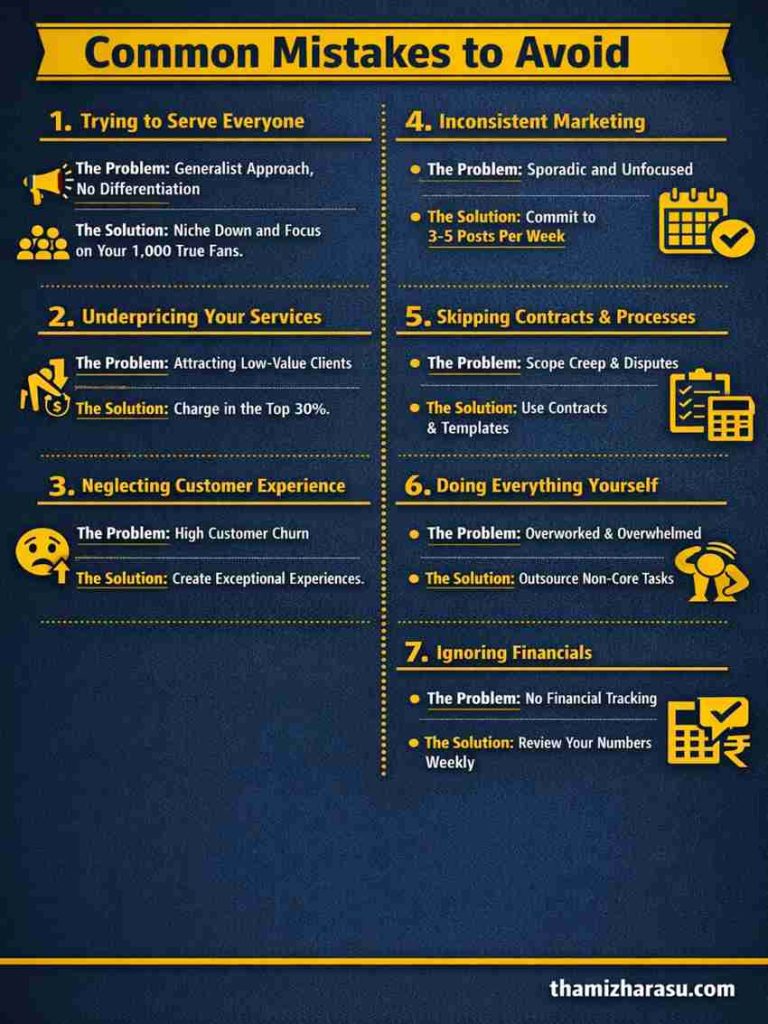
1. Trying to Serve Everyone
The problem: Generalist businesses struggle to differentiate and command premium prices.
The solution: Niche down ruthlessly. It’s better to be the only solution for 1,000 people than one of many options for everyone.
2. Underpricing Your Services
The problem: Low prices attract difficult customers and make profitability impossible.
The solution: Research competitor pricing and position yourself in the top 30%. Customers associate price with quality. Your time is worth ₹8,000-₹16,000/hour.
3. Neglecting Customer Experience
The problem: Focusing solely on acquisition while ignoring retention leads to expensive customer churn.
The solution: Create exceptional experiences. It costs 5x more to acquire new customers than retain existing ones.
4. Inconsistent Marketing
The problem: Sporadic marketing efforts yield sporadic results and make growth unpredictable.
The solution: Commit to consistent marketing schedule (3-5 posts/week minimum). Set aside 10-15 hours weekly for marketing.
5. Skipping Contracts and Processes
The problem: Unclear expectations lead to scope creep, disputes, and burnout.
The solution: Use contracts for every client. Document processes and create templates. Protect yourself legally and operationally.
6. Doing Everything Yourself
The problem: You become the bottleneck to growth, working 60+ hours weekly with no time for strategy.
The solution: Outsource non-core tasks within first 6 months (bookkeeping, admin work, content creation). Your time is worth ₹8,000-₹16,000/hour when focusing on growth activities.
7. Ignoring Financials
The problem: Not tracking expenses, profit margins, or cash flow leads to business failure despite revenue growth.
The solution: Review financials weekly. Know your numbers: profit margin, customer acquisition cost, lifetime value, cash runway.
Frequently Asked Questions {#faqs}
What are the most profitable small business ideas with low investment?
The most profitable low-investment businesses include freelance services (writing, design, consulting), virtual assistance, digital product creation, and social media management. These require under $500 to start and can generate $3,000-$10,000+ monthly within 6-12 months. The key is leveraging existing skills rather than buying inventory.
How much money do I need to start a creative small business?
Most creative businesses require ₹16,000-₹1,65,000 to start, depending on the type. Service-based businesses (consulting, freelancing) need as little as ₹8,000-₹40,000 for basic tools and marketing. Product-based businesses typically require ₹82,000-₹4,10,000 for initial inventory or equipment. Start with the minimum viable version and reinvest profits to grow.
Which small business ideas work best from home?
The best home-based businesses include virtual assistance, freelance writing and design, online course creation, e-commerce (dropshipping or print-on-demand), consulting services, social media management, and digital product development. These require minimal space and overhead while offering flexibility and scalability.
How long does it take to make profit from a small business?
Most well-executed creative businesses reach profitability within 3-6 months. Service-based businesses often profit faster (1-3 months) since they have lower startup costs. Product-based businesses typically take 4-8 months due to inventory investment and longer sales cycles. Consistent marketing and strong initial validation accelerate profitability.
What are unique business ideas that haven’t been done?
Truly unique ideas are rare, but you can create uniqueness through combination and specialization. Consider hybrid concepts like sustainable subscription boxes for specific hobbies, AI-powered services for niche industries, hyperlocal delivery for underserved products, or cultural fusion products. Innovation often comes from better execution rather than completely new concepts.
Do I need a business plan to start a small business?
A formal business plan isn’t necessary initially, but you should have a one-page business model covering your target customer, value proposition, revenue streams, costs, and marketing strategy. This clarity prevents costly mistakes. Create a detailed business plan when seeking investors or loans, or when scaling beyond $100,000 in annual revenue.
How do I find customers for my new business?
Start with warm outreach to personal network, join online communities where your target customers gather, create valuable content consistently, offer beta pricing to early adopters, and leverage local networking events. Once you have initial customers and testimonials, scale through referrals, content marketing, and eventually paid advertising.
What licenses or permits do I need?
Requirements vary by location and business type. Most businesses need a general business license from your city or county. Additional permits may include home occupation permits (for home-based businesses), professional licenses (for regulated services), sales tax permits (if selling products), and health permits (for food-related businesses). Check with your local Small Business Administration office for specific requirements.
Your Next Steps: Turn Ideas Into Action
Starting a creative small business requires more than just a great idea—it demands commitment, strategic planning, and consistent execution. Here’s your action plan:
This week:
- Choose 2-3 business ideas from this list that align with your skills and interests
- Research each idea for 2-3 hours (competitors, demand, profitability)
- Talk to 5-10 potential customers to validate the problem you’re solving
This month:
- Select your top business idea based on research and validation
- Create your minimum viable offer and pricing
- Set up basic business infrastructure (name, website, social media)
- Secure your first 3-5 customers
This quarter:
- Refine your processes based on customer feedback
- Build systems and templates for efficiency
- Develop consistent marketing rhythm
- Reach profitability and positive cash flow
This year:
- Scale to ₹40,00,000-₹82,00,000 in annual revenue
- Hire help for non-core tasks
- Establish yourself as an authority in your niche
- Build a sustainable business that supports your lifestyle goals
Remember: The best business idea is the one you actually start. Choose something that combines your skills, interests, and market demand. Then execute relentlessly.
Every successful entrepreneur started exactly where you are now—with an idea and a decision to take action. Your creative small business journey begins today.
Ready to take the next step? For our free New Business Plan Template and 90 minutes of Expert Consulting – for an Action Plan to turn your creative business idea into reality. Submit the Form below.
Download the Free New business plan Template to kick-start your creative new business.

Leave a Reply
You must be logged in to post a comment.